
Resilience in Operational Contexts: Key Takeaways from the 2026 American Physiology Summit and what it means for pilot and Athlete performance
On April 26th we wrapped up the 2026 Physiology Summit hosted by the American Physiological Society, and one theme kept surfacing across sessions: resilience. It came up in discussions on fatigue, stress, recovery, and long-term performance, and it’s an integral part in both healthcare and operational contexts. But despite how often we use the term especially in aviation and operational settings it’s not particularly well defined.
Going into the conference, I thought I had a solid grasp on resilience. After sitting through a session titled “Redefining Resilience through Exercise Science,” it became clear that while we have pieces of the puzzle, we still have work to do in understanding what it truly means to be a “resilient” human.
When we train, we overload specific systems with the expectation that they will recover, adapt, and become more resistant to future stress. That process of stress, recovery, adaptation is the foundation of resilience. But what actually enables that process to work?
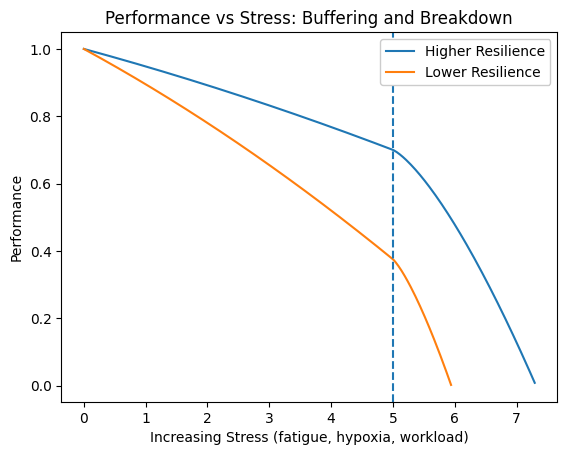
Performance as a function of increasing stress. Greater buffering capacity delays performance decline, but once exceeded, performance drops rapidly.
Here are four key characteristics that underpin resilience in biological and operational systems.
1. Redundancy
For a system to be resilient, it needs built-in backup capacity. If one component fails, another can take over.
The human body is full of redundancy. The lungs, for example, contain roughly 500–600 million alveoli, the tiny structures where gas exchange occurs. If you were to spread them out, they would cover the surface area of a tennis court. This massive redundancy is one reason lung disease can progress silently for so long; the system can tolerate significant loss before function is noticeably impaired. We see the same principle in aviation. Lose a magneto? The engine keeps running. You may lose some efficiency, but the system doesn’t fail catastrophically. Redundancy prevents total system failure but it often comes with reduced performance.
2. Degeneracy
Degeneracy refers to the ability of different structures or pathways to produce the same outcome.
In human movement, if you suffer a minor injury of your ankle, you don’t stop walking, you adapt. You change your gait, redistribute load, and continue moving. The outcome (locomotion) is preserved, even though the system is operating differently.
In aviation, think of losing a glide slope on an ILS approach. Losing the glideslope doesn’t necessarily mean we give up on the approach. Instead, we can adjust and continue. What was a precision approach becomes non-precision, and you adjust your minimums and descent profile accordingly. There are multiple ways to solve the same problem. Resilient systems can switch strategies when needed. We must think of human performance in the same light.
3. Buffering
Buffering is the system’s ability to absorb stress and delay performance breakdown.
A classic physiological example is bicarbonate (HCO₃⁻) buffering in the blood. During heavy and severe-intensity exercise, acid production exceeds metabolism and begins to accumulate. Buffering systems help maintain pH near ~7.4, allowing you to continue producing force despite rising metabolic stress. You feel this when your legs “burn” climbing stairs but that burn doesn’t immediately stop you, and it doesn’t continue forever when you finish your task. That’s buffering in action.
In aviation, buffering shows up in how the body handles reduced oxygen availability at altitude. Early reductions in oxygen saturation (SpO₂) are often well tolerated due to cardiovascular and respiratory compensation. Work from my former student, Hannah Lyons, and her team at Mayo Clinic using direct arterial measurements in healthy adults shows that we can handle these initial drops fairly well. But once saturation falls to around ~92%, that buffering capacity starts to give way, and the decline becomes much more rapid. Buffering buys you time, but once it’s overwhelmed, performance can drop off quickly.
4. Interconnectedness
Resilient systems are not isolated they are integrated. Multiple physiological systems interact to solve problems in real time. This idea is critical in operational environments.
Consider an unexpected in-flight emergency an engine issue, weather deviation, or system malfunction. The immediate response is not just cognitive. It involves:
Autonomic responses (increased heart rate, breathing, arousal)
Cognitive processing (decision-making, prioritization, checklist execution)
Motor control (precise control inputs, communication, task management)
If these systems are well developed and integrated, the response is coordinated:
Arousal increases just enough to enhance focus
Decision-making remains clear
Motor control stays precise
If they are poorly integrated or underdeveloped:
Arousal overshoots (tunnel vision, over-breathing)
Cognitive bandwidth narrows
Fine motor control degrades
Same stressor completely different outcomes. The same processes hold true for military, police, and first-responders in stressful environment’s. This is one reason why training is so essential for performance under pressure. Performance under stress depends on how well your systems communicate and coordinate not just how strong any single system is.
How to Apply This in Training/Life
If you’re training for aviation or other operational environments, the goal isn’t just to increase capacity. It’s to make sure your performance holds up when conditions aren’t ideal. Develop each aspect of the system to build performance.
Build redundancy: Develop multiple physical qualities. Aerobic fitness, strength, and mobility all support performance in different ways. If one system is taxed, another can help carry the load. Raising maximal strength and supporting that strength with improved metabolic control, means you can support a higher power output for longer periods of time.
Train adaptability (degeneracy): Don’t let your training become too predictable. Change environments, vary constraints, and avoid doing everything under perfect conditions. Your body needs practice solving the same problem in different ways. This is especially true for the cognitive aspects of your performance. Are you tired after a long day of work? Sounds like the perfect time to study emergency procedures and reporting requirements for aviation accidents/incidents, because you’ll likely be pretty tired if/when this knowledge is needed.
Improve buffering: Include work that pushes you closer to your limits. Higher-intensity efforts and longer-duration sessions both build your ability to tolerate and manage physiological stress (and the psychological stress that comes with it) before performance drops. Get comfortable being uncomfortable.
Train integration (interconnectedness): Add small amounts of stress to training. This could be fatigue, time pressure, or simple cognitive tasks layered into physical work. The goal is to improve how your systems work together, not just how they perform in isolation.
What matters most here is that you shouldn’t only perform well when you’re rested, focused, and comfortable. Instead, you should be able to perform when you’re a little tired, a little stressed, and a little off your game. Because for aviators and those who push boundaries of performance, that’s the environment you actually operate in.
Bottom Line
Resilience isn’t about being unbreakable. It’s about maintaining function as stress builds. In aviation, performance rarely fails all at once. It degrades over time. The goal is to slow that degradation as much as possible, and recover from it quickly when it happens. That’s what you should be training for.
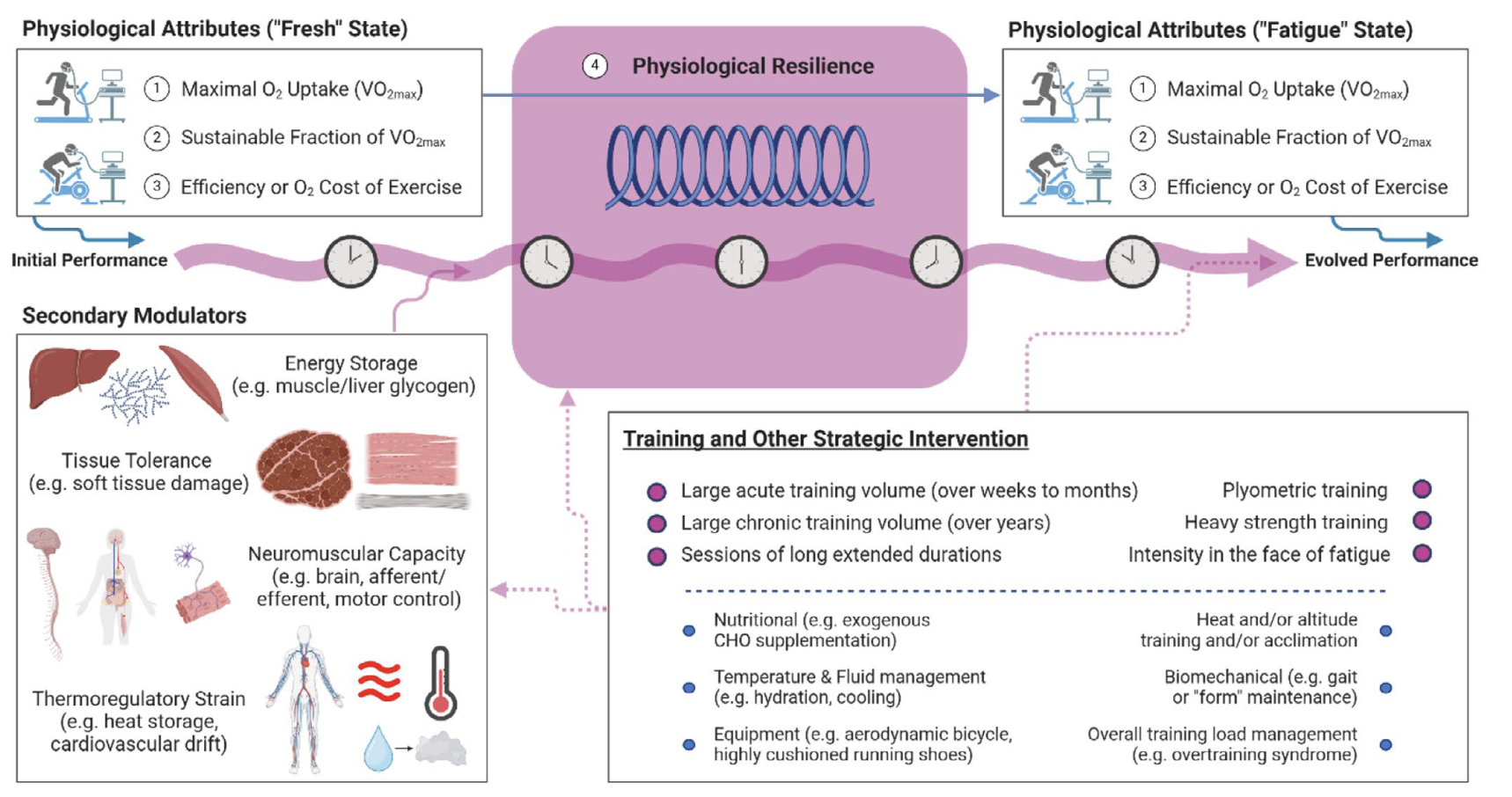
Schematic representation of physiological resilience showing how performance-related systems degrade under sustained stress. Adapted from Jones and Kirby (2025), the figure emphasizes that initial capacity (e.g., aerobic fitness, efficiency) is only part of the equation—what ultimately matters is how well those systems hold up over time. In operational environments such as aviation, this decline directly translates to reduced cognitive, physical, and decision-making performance as fatigue and environmental stressors accumulate.
